Art of Nausicaãƒâ¤ of the Valley of the Wind
Nausicaä of the Valley of the Wind (風の谷のナウシカ , Kaze no Tani no Naushika) is an animated mail-apocalyptic fantasy adventure motion-picture show written and directed by Hayao Miyazaki, that premiered March 11, 1984. Isao Takahata produced the film for publisher Tokuma Shoten and advertizement agency Hakuhodo, with TopCraft animating. Information technology was screened alongside 2 compilation movies for Sherlock Hound, The Adventure of the Blueish Carbuncle and Treasure Under the Sea.
Information technology is based on Miyazaki's manga of the same name, first serialized on Animage magazine on February four, 1982, and completed in March 1994. The story itself was inspired by the 1971 comic Rowlf by American cartoonist Richard Corben, while the proper name Nausicaä was derived from the Greek epic Odysseus. Miyazaki was also strongly inspired past French comic artist Jean Giraud'southward Arzach (1975), as seen in the documentary, Ghibli: The Miyazaki Temple. The picture show has environmentalist undertones and was presented by the World Wide Fund for Nature when it was released in 1984.
Nausicaä is ranked as one of the 50 greatest science fiction films by the Database. While created before Studio Ghibli was founded, the film is often considered to be the beginning of the studio considering of the involvement of Studio Ghibli'south Hayao Miyazaki, Isao Takahata, Toshio Suzuki, Hideaki Anno and Joe Hisaishi. It is frequently included every bit part of the Studio's works, including the Studio Ghibli Collection DVDs and Blu-Rays.
Joe Hisaishi composed the film's musical score. The moving-picture show stars the voices of Sumi Shimamoto, Goro Naya, Yoji Matsuda, Yoshiko Sakakibara and Iemasa Kayumi. Its poster's advertising slogan is, "The love of a girl called a miracle." (少女の愛が奇跡を呼んだ).
The movie won the Animage Anime Grand Prix prize in 1984. In Dec 2019, the story was adjusted into a Kabuki stage play past Shinbashi Enbujō. The moving-picture show also inspired the Tokusatsu tribute brusque, Giant God Warrior Appears in Tokyo, directed by Hideaki Anno and released on July ten, 2012.
At the fourth dimension of its theatrical release, it was screened on 35mm film and the sound was in mono. Its theatrical release posters were painted by famed creative person Yoshiyuki Takani. The film was followed by Castle in the Heaven.
Contents
- ane Opening
- ii Plot
- 2.1 The Princess Who Loved Insects
- 2.2 Annihilation of Pejite
- 2.3 Invasion of Kushana
- 2.4 Resurrection of the God Warrior
- 3 Influences
- 3.i Greek Mythology
- three.2 Rowlf
- three.three Japanese Folktales
- 3.4 SF Influences
- 3.5 Other Influences
- 3.6 Miyazaki's Prototypes
- 4 Behind the Scenes
- 4.ane The Birth of Nausicaä
- four.ii Planning
- 4.3 Product
- 4.four Ending
- 4.four.1 Moving picture vs. Manga
- iv.five Cutting Corners
- 4.vi Nausicaä Girl Contest
- v Release
- 5.1 Managing director'due south Thoughts
- vi Sequel
- vii Music
- 8 Manga
- 9 Vocalism Cast
- 9.1 Additional Voices
- x Credits
- 11 Related Products
- 11.1 Home Video
- 11.2 Printed Media
- eleven.3 Movie related
- 11.4 Music
- 11.v Toys, models, etc.
- 12 References
- 13 External Links
- 14 Navigation
Opening
| ||
Plot
The Princess Who Loved Insects
"Main Yupa!"
"Nausicaä, you've grown! I almost mistook y'all you for someone else."
"It has been a year and a half! Male parent will be delighted. I must thank you. You've become a fine wind-user."
"No, Father says not even so."
"Oh, yes... I completely forgot about this boyfriend."
"My! A fob-squirrel."
—Yupa introduces Nausicaä to Teto
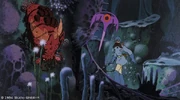
Nausicaä exploring the forest nearly the Body of water of Corruption.
One chiliad years have passed since the Seven Days of Fire, an apocalyptic war which destroyed human being culture and most of the Earth'due south original ecosystem. Scattered man settlements survive, isolated from ane some other by the Sea of Decay. The Sea of Decay is a jungle of giant plants and fungi swarming with giant insects, which seem to come together but to wage state of war. Everything in the Sea of Disuse, including the air, is lethally toxic.
Nausicaä is the agile and cheerful immature princess of the peaceful Valley of the Wind. Although a skilful fighter, Miyazaki'due south Nausicaä is humane and peace-loving. She has an unusual gift for communicating with the giant insects (especially with the Ohmu, the gigantic, armored, caterpillar-like insects who are the near intelligent creatures in the Sea of Disuse). She is besides noted for her empathy toward animals, humans, and other beings. An intelligent girl, and inspired by the mentor figure Yupa, a wandering samurai type possessed of nifty wisdom, Nausicaä ofttimes explores the Sea of Disuse and conducts scientific experiments in an attempt to define the true nature and origins of the toxic globe in which she lives. Her explorations are facilitated past her skill at "windriding"; flying with an advanced glider-like craft with a jet assist called a möwe. Yupa is searching for the mythological human being in blue who, co-ordinate to the fable, volition appear surrounded past a sea of gold and reunite the people and nature.
Annihilation of Pejite
"In the midst of my travels, I heard an ominous rumor... It said that a monster from the ancient world had been excavated from beneath the city of Pejite, where it was sleeping."
"A monster from the aboriginal globe?"
"It's a God Warrior."
"A God Warrior?! You lot hateful, the ones that burned the world in the Seven Days of Burn...?! This matter..."
"The Giant Guardians must all have been completely fossilized..."
"Just the boyfriend continued to slumber underground for 1000 years."
"Ah! If so, this beau would have human form."
—Yupa and Mito discuss the discovery of a God Warrior

Nausicaä saves the reckless Asbel from devastation.
Ane day, an airship (a kind of large cargo airplane) crashes onto the cliffs nigh the Valley of the Air current. Nausicaä tries to rescue a mitt-cuffed daughter of her age from the burning wreck, but she dies later telling that she is Princess Lastelle from the kingdom Pejite and that the cargo of the balloon must be destroyed. The balloon is from Tolmekia and the cargo turns out to be a God Warrior (kyoshinhei embryo, Behemothic Warrior in the English language release), one of the lethal, behemothic, biological weapons used in the ancient war.
It is afterward revealed that the God Warrior embryo was unearthed past Pejite, only it was stolen by the more than powerful state of Tolmekia (Tormekia in the manga). While transporting the Warrior dorsum to their realm, the Tolmekians were attacked past insects and later bump in the Valley. The very side by side twenty-four hours, the Tolmekians, under the leadership of princess Kushana, invade the Valley to kill the Valley male monarch and to secure and revive the Warrior. Kushana explains that the God Warrior will be used to burn the Ocean of Decay, although Obaba, an erstwhile and bullheaded Valley adult female warns that attempting then will only enrage the Ohmu and lead to more deaths.
Invasion of Kushana
"The reason the Wasteland came to exist...? You lot're a daughter who thinks strange things."
"Humans polluted the trees of the Wasteland. They came to be born in order to purify this world... Taking the Earth's poisons into their bodies, they become pure crystals, and dice, condign sand. This underground cave could do the aforementioned matter. The insects are protecting those trees..."
"And if and so, we can't just destroy them. How many thousands of years have nosotros suffered? It's no apply living in fear of the vapors and the insects. At the least, we need a way to keep the poisonous substance from spreading more than it has."
"You lot talk the same style Kushana does..."
"You're wrong! We aren't planning to use a God Warrior in battle! Tomorrow, if you see anybody, you'll understand!"
—Asbel speaking with Nausicaä
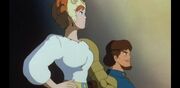
Kushana, Imperial Princess of Tolmekia, orders the annihilation of the Pejitan people.
Kushana attempts to return to Tolmekia, with Nausicaä and several others as hostages. Earlier their divergence, Nausicaä reveals to Yupa a hidden garden of jungle plants, that are not toxic because they are growing in sand and h2o from a deep well. Nausicaä explains that the jungle is only toxic due to the toxic soil that is everywhere on the surface of the world. The airships with Kushana and Nausicaä are attacked past a Pejitan gunship and several of the ships are forced to make an emergency landing in the Ocean of Disuse. There, Nausicaä communicates with several ohmu and discovers that the pilot of the Pejitan gunship is still live. With the assist of her glider, Nausicaä rescues the pilot from a swarm of enraged insects. However, they crash and end up in a strange, non-toxic earth that is below the Body of water of Decay; the plants in the Sea of Decay purify the polluted soil, and in this way produce make clean h2o and sand, which remains hidden in this surreptitious world. The pilot turns out to exist Asbel of Pejite, the twin brother of princess Lastelle.
Nausicaä and Asbel return to Pejite, which turns out to be destroyed afterward the Pejite people lured the insects from the Sea of Decay into their town in order to kill the occupying Tolmekian forces. The Pejite people reveal that they will do the same affair to the Valley of the Winds in order to recapture the God Warrior. To prevent Nausicaä from alerting the Tolmekians, they capture her, merely she escapes with the assist of Asbel. With a gunship, she returns to the Valley, but along the way they encounter an enormous herd of enraged Ohmu who are on their mode towards an injured baby Ohm, which is used by the Pejite people to lure the Ohmu to the Valley. Nausicaä releases the baby Ohmu and gains its trust.
Resurrection of the God Warrior
"Oh... What sympathy and friendship it is... The Ohmu are opening their hearts... Children - substitute for my blind eyes and wait well for me."
"The Princess is wearing a deep blue dress. It looks just similar she's standing in a gold field..."
"Oh!! That person, wearing a blue robe, shall stand in a gilded field..."
"Grandma?"
"She used the sometime words..."
—Grandma and a young girl witnessing Nausicaä'southward resurrection
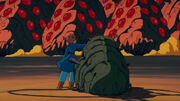
Nausicaä stands along against the rampaging Ohmu.
In the meantime, the Tolmekians endeavor stopping the herd with armored vehicles they brought with them but to no effect, later Kushana arrives with the God Warrior to stop the Ohmu herd, but the Warrior, woken too early, dies in the process. However, Nausicaä, with the baby Ohmu, is finally able to cease the Ohmu herd, but she is overrun and slain in the process. In front of the Valley people and the Tolmekian forces, the Ohmu use their gold-colored tentacles to revive Nausicaä, whose apparel has turned blue past the babe Ohmu'due south claret; thus Nausicaä turns out to be the mythological "human" in bluish mentioned in the beginning. The flick ends with fragments of a future where people and insects live in peace with each other.
The story holds deeper significant than its depiction of state of war; there are both environmental and ecological subtexts in Miyazaki's narrative. Fifty-fifty the insects seem to be working toward some hush-hush harmony and the lethal fungal forest seems to have a vital role in Globe'due south new ecosystem.
Influences
Greek Mythology
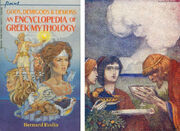
Hayao Miyazaki preferred Bernard Evslin's interpretation of Nausicaä in his book Gods, Demigods & Demons: Encyclopedia of Greek Mythology over the version seen in Homer's Odyssey.
In an Animage interview on the origins of Nausicaä, Hayao Miyazaki explains that her name is the name of a Phaeacian princess who appears in the Odyssey. He first learned of her from Bernard Evslin's book Gods, Demigods & Demons: Encyclopedia of Greek Mythology (published as part of Shakai Shisosha'south Modernistic Educational Pocketbooks series translated by Minoru Kobayashi), and was instantly attracted to her. After he read a novelization of Homer'south Wikipedia:Odyssey Odyssey, he found information technology lacking because, in that version, Nausicaä wasn't about every bit appealing as she was in Evslin's volume.
Miyazaki describes Nausicaä as a "fleet-footed, fanciful, beautiful girl. She loves her harp and singing more than than any suitor or ordinary happiness, and her boggling sensitivity leads her to please in playing amid nature. When Odysseus is shipwrecked and injured, rather than being afraid of his bloodied class, Nausicaä treats his wounds. And information technology is Nausicaä who melts his eye with her improvised Odysseus'southward ship sail out of sight. According to one fable, Nausicaä watches Odysseus'due south ship sail out of sight. Co-ordinate to i legend, Nausicaä thereafter never married and spent her years wandering from court to court every bit the first traveling female minstrel, singing near Odysseus and his voyage of take a chance."
Indeed, every bit Evslin wrote at the finish of his department on Nausicaa, "Whatever the example, she had a special place in the heart of the weather-beaten voyager."[1]
Rowlf
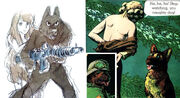
Early on concept art by Miyazaki took inspiration from Rowlf by Richard Corben.
The flick and its manga counterpart were originally inspired by the 1971 hush-hush comic Rowlf by American cartoonist Richard Corben, which is about "a princess carrying the fate of a small country." The story is set in the Medieval kingdom of Canisland, where Rowlf is devoted to his large-breasted mistress Maryara, and hostile towards her suitor, Raymon. Miyazaki proposed to Tokyo Movie Shinsha to larn the copyright for Rowlf. In his proposal to acquire the writes to Rowlf, Miyazaki writes:
"I think that Rowlf would be an ideal for a theatrical feature film targeting the American market. It definitely is non for little children (i.e., not for a TV audience) merely if handled properly it could potentially entreatment to all classes of immature Americans and surpass the appeal of Ralph Bakshi's Wizards. The images in Rowlf may seem unfamiliar and grotesque to Japanese audiences, just past massaging them and making them more than digestible, I believe the film could as well attract young Japanese audiences." [2]
Miyazaki felt Rowlf would have been an platonic project for young people of that fourth dimension who felt "over-managed, overprotected, and suffocated by society", or who found their choices increasingly limited and thus are "increasingly neurotic."
By 1983, Miyazaki would later put forth these film projects following this ethos of offering "a liberation to nowadays-day immature people..." by cartoon a manga that incorporated those feelings for Animage. That manga would exist somewhen Nausicaä of the Valley of the Wind.
Japanese Folktales
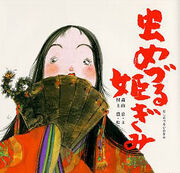
A moving-picture show book of The Lady Who Loved Insects.
Miyazaki modeled Nausicaä after the The Lady Who Loved Insects (虫めづる姫君 , Mushi-mezuru Himegimi), a twelfth-century Japanese tale of i who defies social convention and breaches the decorum expected of a Heian court lady. At a time when almost girls would accept shaved their eyebrows and stained their teeth black, this was most unusual.
It is one of 10 curt stories in the collection Tsutsumi Chūnagon Monogatari (Tales of the Tsutsumi Center Counseler). Miyazaki muses, "In an age of classics similar The Tale of Genji or The Pillow Book, there was no mode social club could tolerate a young noblewoman falling in love with bugs and going effectually with unshaved eyebrows. Even every bit a child, I was always extraordinarily curious about what happened to her after."
SF Influences
Miyazaki took inspiration from diverse classic science fiction media, such as René Laloux animated motion-picture show Fantastic Planet (1973) and manga artists Osamu Tezuka, Daijiro Moroboshi (peculiarly Moroboshi'southward gritty way).
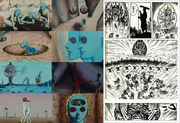
René Laloux'due south 1973 film Fantastic Planet and the works of Daijiro Moroboshi helped inspire the style of Nausicaä.
He was also strongly influenced by French cartoonist Jean Giraud Moebius's [[Wikipedia:Arzach Arzach] (1975), of which Miyazaki admitted while speaking with Moebius during a articulation exhibition in France. These events can be seen in the 2005 documentary, Ghibli: The Miyazaki Temple. In add-on, Miyazaki derived ideas from Sasuke Nakao's "East Asian Evergreen Wood Civilization Theory" which establishes the relationship between the Syvash (Putrid Sea or Rotten Sea) and humanity.
Other influences include various SF novels such as Pastel City by Thou. John Harrison. The starting time Viriconium novel, The Pastel City (1971), presents a civilization in decline where medieval social patterns disharmonism with advanced applied science and superscience energy weapons that the citizens of the city know how to use but accept forgotten how to engineer. Harrison's leading grapheme, Lord tegeus-Cromis, fancies himself a better poet than swordsman; yet he leads the battle to save Viriconium, the Pastel City, from the encephalon-stealing automatons known as the "geteit chemosit" from Earth's past.
Miyazaki was also inspired past Long Afternoon of Globe, by Brian Aldiss and Dune by Frank Herbert.
Other Influences
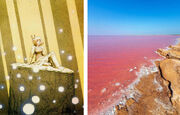
Tribute art of Nausicaä by Moebius, and an image of the Syvash or Sivash, also known every bit the Putrid Sea or Rotten Sea in Crimea.
Miyazaki fondly remembers the line where the woods moves when he read Macbeth as a child, and has carried this idea in wanting to write a story that dealt with plants.
Some of the names of people and places that appear in both the film and the manga resemble bodily historical matters. For example, Kushan is the proper noun of the Indian dynasty (Kushan dynasty), the name "Hephthalite" is the name of an actual nomadic race, and Miralpa is based on a existent Tibetan Buddhist practitioner (Milarepa).
Miyazaki cites that the Valley of the Wind is inspired by Key Asia, notably the rotting ocean of Syvash in Crimea, Ukraine. There is a place chosen the "Valley of the Winds" on Mount Olga (Kata Tjuta) in Australia, only according to Studio Ghibli, it is not relevant.
Miyazaki's Prototypes
Miyazaki's first serialized manga People of the Desert (砂漠の民 , Sabaku no Tami), which ran from September 12, 1969, and March 15, 1970, is ready in Central Asia, which features the royal capital of Pejite.[3]
Another early version of Nausicaä can be seen in Miyazaki's ane-book watercolor-illustrated manga The Journey of Shuna, published past Tokuma Shoten on June fifteen, 1983. Based on the Tibetan folk tale Prince who Became a Domestic dog, Miyazaki describes the folk tale as a story of "the prince traveled westward."
Backside the Scenes
The Birth of Nausicaä
"Even though I thought information technology was a waste of time, I didn't get any requests from anywhere, and all the (movie) plans I put out were turned down. That kind of affair has been going on for the terminal 3 years and it's been really hard."
—Hayao Miyazaki, after the box office failure of The Castle of Cagliostro
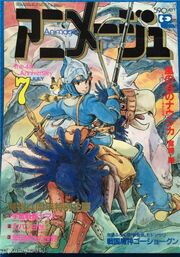
The 1982 event of Animage promoting the beginning chapter of the Nausicaä of the Valley of the Wind manga.
Hayao Miyazaki fabricated his credited directorial debut in 1979 with The Castle of Cagliostro, a pic which was a distinct departure from the antics of the Lupin Three franchise, only notwithstanding went on to receive the Ofuji Noburo Honour at the 1979 Mainichi Film Concours. Although Cagliostro was a failure in the box office, Toshio Suzuki, editor of the magazine Animage, was impressed past the film and encouraged Miyazaki to produce works for Animage's publisher, Tokuma Shoten. The box function thwarting of Cagliostro meant that many of Miyazaki'southward motion-picture show ideas were rejected, and Tokuma asked him to do a manga: this led to the creation of Nausicaä of the Valley of the Wind.
Miyazaki began writing and drawing the manga in 1979, and was serialized on Animage in February 1982. Information technology proved to be extremely popular, and by November 1982, Miyazaki left Telecom Animation Moving-picture show to focus on his manga work. Animage Editor-in-Chief Hideo Ogata proposed to adapt it into a ten-infinitesimal short moving picture to be screened at the Anime Grand Prix, an Animage sponsored effect, however Miyazaki declined.[4] A 70-minute OVA project was later proposed, but was abased after the projection was deemed non profitable.[five] The proposal for a feature-length anime accommodation was finally accepted after Ogata struck a bargain with Yasuyoshi Tokuma, president of Tokuma Shoten to co-sponsor the production.[6] Miyazaki initially refused, simply agreed on the status that he could straight.
Despite having a picture show division in Tokuma Shoten, the visitor had piffling experience in producing animated projects. Bandai, who had partnered with TV Land magazine, proposed a deal to exist a joint investment company, but the bargain fell through. The president of Hakuhodo, a major advertising agency, and Yasuyoshi Tokuma decided to invest after a meeting between both executives.[7] Fortunately, Miyazaki's younger blood brother worked at Hakuhodo, and the determination was made to release it on a national "road show".
Toei was prepare to distribute the film, but had little organized religion information technology would practise well in the box role and were because lowering its advert budget. Yasuyoshi Tokuma one time over again came in and convinced Toei President Shigeru Okada that Nausicaä would be a large hit. Nether Tokuma'south direction, Tokuma Japan handled the majority of promotional activities.
Planning
"I want Mr. Takahata to exist a producer."
—Hayao Miyazaki
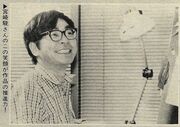
Hayao Miyazaki grinning as he worked on Sherlock Hound and his Nausicaä manga at the aforementioned time.
Past 1983, Toshio Suzuki asked who Miyazaki wanted as producer for his new picture show. Without hesitation, Miyazaki said, "I desire Mr. Takahata to be a producer," Suzuki idea, "I see, that's good!" Takahata had collaborated with Miyazaki on numerous works prior, from Horus, Prince of the Sun (1968) to Heidi, Girl of the Alps (1974) to Future Boy Conan (1978). Takahata was initially reluctant, saying "I am not suitable for a producer". Following that, Suzuki persistently tried to persuade him every day for more than a calendar month, but Takahata stubbornly refused. Finally, Suzuki gave upwards and asked, "Mr. Miyazaki, would you like someone else to be the producer?"
Miyazaki sat in silence for a while, and eventually said, "Mr. Suzuki, let's go for a potable." When the two entered a bar, Miyazaki suddenly started drinking sake. Suzuki, who had never seen him drink earlier, was surprised. Miyazaki drank alcohol as if he were alone (Suzuki seemed to be unable to drinkable a single drop of alcohol).
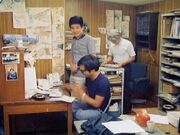
Hayao Miyazaki worked with Isao Takahata on the Lupin III series prior to Nausicaä.
Miyazaki, at present drunk, began started crying out loud. Amidst his wailing, he began complaining in earnest, "I take defended my whole youth to Isao Takahata for fifteen years!" Mr. Suzuki had no words to say, and had no pick but to keep listening to the director'due south complaint.
That same evening, Suzuki rushed to Takahata'south house and said, "Mr. Takahata, delight take the role of producer!" Isao Takahata attempted to refuse, "No, it's non suitable for me equally I said before..." After a tense back and forth, Suzuki'due south patience ran out. "Miyazaki-san wants you to do it! Isn't he an important friend of yours? You're in so much trouble if you don't you help!" Takahata, surprised at this, finally agreed, "I understand. I will practice information technology."[8]
Isao Takahata, credited equally executive producer, reluctantly joined the project after being convinced by Toshio Suzuki.[nine] This was done fifty-fifty earlier the blitheness studio was chosen. An outside studio to produce the film was needed because Tokuma Shoten did not ain an animation studio: Miyazaki and Takahata chose the minor studio [TopCraft]]. The production studio'southward work was known to both Miyazaki and Takahata and was chosen because its artistic talent could transpose the sophisticated atmosphere of the manga to the film.

Hayao Miyazaki relaxing with Sumi Shimamoto, the voice actress of Nausicaä at Shinanosakai, Nagano Prefecture in September 1984.
On May 31, 1983, work began on the pre-production of the film. Miyazaki encountered difficulties in creating the screenplay, with simply sixteen capacity of the manga to work with. Miyazaki would have elements of the story and refocus the narrative and characters to the Tolmekian invasion of Nausicaä'south homeland. Takahata would enlist the experimental and minimalist composer Joe Hisaishi to do the score for the film.
Production
Miyazaki et al. were considering commissioning Telecom Animation Film or Nippon Blitheness for the product.[ten] Both companies refused, proverb "We are currently working on another piece of work, and so the staff cannot beget it." Telecom had previously worked with Miyazaki on The Castle of Cagliostro (1979) just declined as they were currently working on the animated adaptation of Little Nemo .[xi] They approached Tokyo Movie and Toei Animation and were also met with a harsh response, "I know that Mr. Miyazaki will make practiced works, but the demands are too strict and the staff and the company will exist left in tatters..."
Just as they were about to run out of options, Isao Takahata, who had just taken the role every bit a producer, pulled them out of their crunch. Since Nausicaa was Takahata's start experience equally a producer, he had to written report the process from scratch, setting upward an accurate product system that was not bound by conventional community and common sense. To be a skillful producer, he needed to Miyazaki to simply worry near his storyboard and directing work while he handled the residuum. He needed to secure a base and staff and a budget for each department with as well.
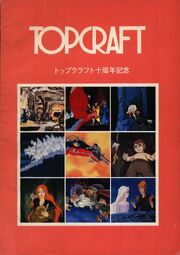
TopCraft famously worked on The Last Unicorn. Released in 1982, they later worked with Miyazaki on Nausicaä.
Nausicaä was produced with animators hired for the one flick and paid per frame. Key animation piece of work began in August 1983. TopCraft's president Toru Hara, was a former a colleague of Miyazaki and Takahata's while they were working at Toei, and were mainly involved in overseas co-productions.
The biggest hurdle Miyazaki faced is how to adapt his ain original work, without losing its essence and intention, "If it's someone else's cloth, you (as a director) can modify it without hesitation, but if it'south something (you lot made), it's not like shooting fish in a barrel to be objective. Even if it is not drawn out from the original material, at that place is anguish and feelings in the dorsum of each frame. The motifs in the film were based on the original, only it was hard because we had to re-gild the scenes while changing their meaning / context, and so wrap information technology all together in 'furoshiki' so that everything would fit (the runtime) of the motion picture."
In order to reduce the burden on Miyazaki on adapting his own work, they hired Kazunori Ito to produce the screenplay. Ito, a regular collaborator of managing director Mamoru Oshii, is credited of producing such classics as the Urusei Yatsura series and Patlabor. Unfortunately, the resulting script Ito wrote exceeded iii hours. Co-ordinate to Mr. Ito, "I didn't call up it could be packed in more 110 minutes by any means." With Ito's script delayed, Miyazaki proceeded to work on storyboards. In the stop, Ito couldn't fit the entire story in the film'southward 110 minute runtime and left the project. Miyazaki, frantic at this latest development, rushed into production leaving the catastrophe even so undecided.
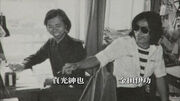
Director Shinya Sadamitsu on the left and Yoshinori Kanada on the right working on another blithe movie chosen Birth. Kanada is wearing his trademark sunglasses, which he wore even when cartoon, until he worked on Nausicaä.
Takashi Nakamura from Tatsunoko Product, Yoshinori Kanada, who was popular for his work on "Kanada Perth," were hired as key animators. At the time, Kanada was living in the neighborhood where Takahata lived, and he was a huge fan of his and Miyazaki'southward piece of work. Suzuki who was delighted afterwards he was hired, saying "This is lucky!" Kanada cited his kickoff piece of work had been on Panda! Go, Panda! (1972). He would go along to become an influential member of Studio Ghibli, afterward working on Princess Mononoke in 1997.
The production faced issues in unifying the animators' drawing styles. Processes were prepare to check each and every frame of animation and then that the moving picture'south wait would remain consequent. The staff consisted of animators from TopCraft, Oh! Production, and Free Animator. The core drawing staff consisted of nineteen artists (at to the lowest degree 4 or v from TopCraft alone), reaching as many every bit 30 at some betoken.[12] The reason for the large number of animators was due to how many were confused by the Miyazaki'southward detailed layout and 'drawing bank check system', resulting in numerous delays. Equally the number of animators increases, the individuality of each drawing naturally disperses, and the sense of unity in the blitheness is lost. Miyazaki struggled working from early morning to late night to right whatsoever errors.
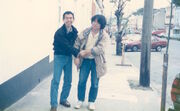
Toshio Suzuki hanging out with Mamoru Oshii.
As a result, many of the expressions of characters in the picture show were rough and unrefined. Massive crowd scenes were reduced into yet images. In that location was one vivid spot - Yoshinori Kanada contributed massively to the quality of the picture by creating dynamic activeness scenes and stiff graphic symbol poses. Miyazaki praised Kanada, saying he is "A rare animator with elements that give physiological pleasure in pictures and movements." Kanada would go on to work on 100 cuts, commonly centered on flashy explosions and action set pieces involving Asbel'southward surprise attack on Kushana's forces or the crashed Pejite send.
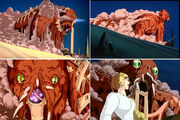
The spectacular God Warrior sequence by Hideaki Anno.
Miyazaki faced some other issue - he could non find an animator that was willing to do the climactic scene involving the God Warrior firing upon the Ohm. Hideaki Anno, who subsequently produced Neon Genesis Evangelion and the 2012 Tokusatsu tribute film Giant God Warrior Appears in Tokyo, was also hired subsequently seeing an advertizing for Animator Urgent Recruitment on Animage. Anno, who was skilled in drawing mechanical objects and explosions, was assigned to draw the challenging God Warrior'due south attack sequence, which according to Toshio Suzuki is a "high point in the film". At offset, Miyazaki was worried no animator could describe characters and mecha well at the same time, and that he would have to constantly correct their work. In the finish, Anno drew all the giant warriors, tanks, and explosions, and Miyazaki repainted only the characters in the second original key cartoon. "It was a very luxurious collaboration (laughs)." Miyazaki recalls.
Ending

Nausicaä's resurrection and revealing the truthful nature of the Sea of Decay was supposed to trigger a "Copernican-like revolution on understanding" in her lodge, but Miyazaki felt it fell brusque to many of the ideas he had in listen.
The final storyboard sequence involved Nausicaä getting crushed past the rampaging Ohmu. During a meeting in a local teahouse, Miyazaki presented this scene to Takahata and Suzuki and said, "Hither is the end mark." Toshio Suzuki and Isao Takahata, who saw the storyboard, were silent for a while. Takahata asks, "What do you think, Mr. Suzuki?" Suzuki answers, "Hmm, it'south a bit unpleasant to finish." After several hours of word, they came up with three possible endings:
- Program A: "The Ohmu rushes towards Nausicaä and she stands earlier them. The picture of a sudden ends."
- Plan B: "The Ohmu rushes towards Nausicaä is blown away. Nausicaa dies."
- Plan C: " Nausicaä is diddled away, but then come up back to life. "
Takahata and so asks, "Mr. Suzuki, which of these three is better?", "Would you like to die and revive?". As the deadline for the motion picture's release drew closer and closer, they had lilliputian fourth dimension to decide. They told Miyazaki to consider "Programme C", to which he replied, "I understand, I will practise information technology." Suzuki replied, "Is information technology okay to decide so hands even though it's an important terminal scene?"
After the picture was released, Miyazaki expressed some regret on his decision, "That last scene is a regret." He subsequently elaborated, "That's all y'all can exercise with the picture show. It's important that Nausicaa, the heroine, discover the real role, construction, and significance of the fukai, or Sea of Decay, and as a result trigger a Copernican-like revolution in understanding. I had decided that was about all I could show ina picture version, but there were too many elements still in my mind that wouldn't fit into that simplified and information technology bothered me that I couldn't make them work. It'south no wonder there were problems, because in the manga I essentially decided to write about whatever I wasn't able to depict in the film."[thirteen]
Flick vs. Manga
In 1994, after the completion of the manga, Miyazaki was asked how the two version'southward ending differed and the choices he made, with the film existence more open ended whereas the manga had a more definitive catastrophe. He explained that, "If I always had to go dorsum and redo everything and make the film first, I'thou sure I would do the same thing. There would be no changes." and that it would've been "ridiculous" to keep cartoon the manga story later the flick ended.
"As I indicated before, films have an "end mark" or articulate ending, so I didn't proceed creating the manga story in an attempt to follow the film'due south story. I frankly didn't worry almost what I had done in the film at all. Mainly considering I'd already forgotten nigh of information technology. [laughs]
Yet, especially in the initial stages of making the Nausicaä picture show, I kept insisting that the story only represented a wish on my role, that I wasn't working from any causeless reality. But when the film was finished I discovered that I was actually up to my neck in the religious zone I had e'er wanted to avoid; I seriously felt that I had backed myself into a corner, and though, "Uh-oh..."
On finishing the film, I told myself that if I were going to continue the manga serialization I would have to have a more no-nonsense approach. While creating the manga however, I too realized there were so many things I didn't understand that I would have to continue going without ever figuring them out. [14]
Cut Corners
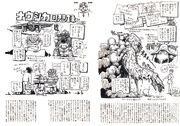
Artistic depiction of Hideaki Anno working for Hayao Miyazaki.
Product ramped upwards in the final months before its release. TopCraft lacked the manpower and Suzuki put out more animator recruitment ads on Animage. Miyazaki took the initiative to work early in the morning and work overtime late at nighttime, and demanded that the staff work devote all their efforts to improving the quality of the work. The staff returned from the holidays and work until midnight until Dec 31st. Miyazaki himself drew many of the cardinal drawings and layouts, working without break from 9am to 3pm. He had near reached his limit and appealed to Takahata and Suzuki, "We will never exist in time for the release date!"
Takahata organizes an emergency meeting with the staff. Miyazaki thought Takahata would propose some sort of breakthrough, but instead said "We have no choice but to filibuster." Everyone, including Suzuki, who was present at the show, was and then stunned that he couldn't fifty-fifty speak out. For Takahata, information technology was more important to "keep the quality of the movie" than to "finish it by the deadline". After bad-mannered silence due to Takahata's remarks, Miyazaki was furious, saying, "I tin can't say anything more because the producer says this."
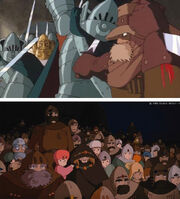
Several elaborate action sequences and big crowd shots were cut due to manpower shortage and a looming borderline.
Post-obit this, the staff worked mean solar day and night. Miyazaki decided to cut corners by not animative large crowd scenes. The planned final fight between the God Warrior and the Ohmu, which was storyboarded, was completely cut. The 2nd half of the film had a complicated action scene involving Yupa fighting off Tolmekian soldiers. That too was cut, with i character remarking 'I don't accept fourth dimension!' The soldiers are killed with a unproblematic depiction of a quick flash.
Afterward when Hideaki Anno saw this scene, he joked, "This is where it suddenly looks like Ishikawa Goemon (from Lupin III) (laughs)." However, as a result of mercilessly cutting scenes, work efficiency gradually improved, and they were miraculously able grab up with the proposed release date. By February, much of they animation had been drawn, but the cels were yet to exist painted. The painting team, comprised mostly of women, scrambled and worked nearly 24 hours a day. Suzuki noted i woman couldn't go home for three days straight, wearing the same clothes the entire time.
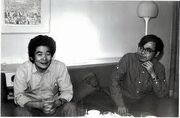
Miyazaki relaxing with Isao Takahata, who he endearingly called "Paku-san".
The producers scrambled for three months to complete the motion picture'southward sound mixing. Phonation actors wore special masks made of condom fastened to a paper loving cup while recording sure scenes. The technique required diverse trials and errors until the proper effect was achieved.[xv]
The film was released in March 1984, with a production schedule of only nine months (May 31, 1983 to March 6, 1984) and with a budget equivalent to $one million. Over 56,078 drawings were made, and 263 colors were used.
Nausicaä Girl Contest

Narumi Yasuda was chosen as the motion-picture show's "paradigm girl" during the Nausicaa Girl Competition in 1984.
Prior to the film's release in 1984, the company sponsors held Nausicaa Daughter Contest to select an "image daughter" for the pic. Narumi Yasuda, who turned 18 at the time, was chosen out of 7,600 applicants. They announced that Yasuda would sing the theme song to Nausicaa of the Valley of the Wind that would be featured in the film, merely Miyazaki and Takahata opposed this as they felt there would be a discrepancy between the contents of the pic and the song.
In the cease, the vocal was only used in theatrical trailers and TV spots, but did make it into the film at the finish credits.
Release
| State | Release Date | Format | Publisher |
|---|---|---|---|
Japan  | March xi, 1984 | Theater | Toho |
| Nihon | April 1984 | Laserdisc | Tokuma Shoten |
USA  | June 1985 | Warriors of the Wind | Manson International and Showmen |
| Nihon | Winter 1991 | VHS Re-Issue | Tokuma Shoten |
| Japan | Winter 2003 | VHS Re-Issue | Buena Vista Home Entertainment |
| United states | Winter 2005 | DVD | Disney |
| Japan | May 2008 | DVD Re-Issue | Buena Vista Habitation Entertainment |

Warriors of the Current of air was the outset localization of Nausicaä.
The picture was originally released by Toei Company in Japan on March 4, 1984, and sold 915,000 tickets and distribution revenue reached 740 million yen.
A heavily edited and English-dubbed version of the film was released theatrically in North America, shown on HBO and released on VHS by New World Pictures & Manson International in the 1980s as Warriors of the Wind. Co-ordinate to Nausicaa.internet, the voice actors and actresses were non even informed of the film's plotline and more than thirty minutes of the movie were cutting from the film because New World felt that "the parts were tedious moving". As a event, role of the flick'due south narrative meaning was lost; some of the environmentalist themes were diluted as was the main subplot about the Ohm, contradistinct to turn them into aggressive enemies. Virtually of the characters were renamed (for example, Nausicaä became "Princess Zandra"). The comprehend for the VHS release featured a cadre of male characters, who are non part of the flick, riding the resurrected God Warrior — including a still-living Warrior shown briefly in a flashback. It was released around the world nether various different titles, such as Sternenkrieger (literally "Star Warriors") in Deutschland. It was rumored that June Foray provided the vox of Zandra, though this has been proven as false.
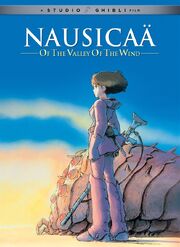
Habitation video encompass art for Nausicaä.
Many fans of Nausicaä, forth with Miyazaki himself, dislike this version; Miyazaki suggested that people should put it "out of their minds." Studio Ghibli and Miyazaki accept asked fans to forget its existence, and they later adopted a strict "no-edits" clause for future foreign releases of its films. On hearing that Miramax co-chairman Harvey Weinstein would try to cut Princess Mononoke to brand it more marketable, Toshio Suzuki personally gifted a replica katana with a uncomplicated bulletin: "No cuts".
The rating of this flick is PG in both the United Kingdom and US.
An uncut and re-dubbed version of Nausicaä was released on DVD by Buena Vista Home Amusement on Feb 22, 2005, for Region i. This DVD likewise includes the Japanese audio track with English subtitles. Optimum Home Entertainment released the film in Region 2, and the Region 4 DVD is distributed by Madman Amusement. The 2005 DVD version made it around the globe uncut.
Director's Thoughts
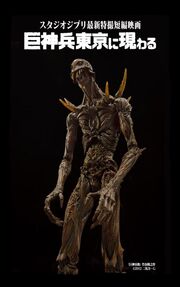
Hideaki Anno directed a alive action kaiju tribute motion picture, Behemothic God Warrior Appears in Tokyo on Nov 17, 2012.
Despite being massive critical and commercial hit, Miyazaki felt the moving-picture show only deserved a rating of 65 points. "I fabricated it by skipping all the legitimate production procedures of the flick, just I still haven't grasped the theme. Even if I had some other six months, I would have only reached 68 points."
Takahata was even harsher, giving the moving picture a score of 30 and saying, "Miyazaki-san is not only a director, but a author, so I wanted him to move on to a newer horizon. Information technology's disappointing that nosotros're looking dorsum on the present from the hereafter."[16] Miyazaki lamented, "There was no other mode the picture would fit in two hours." The production also left Miyazaki burnt out. "I take to tell you something," Miyazaki confided to collaborator and friend Toshio Suzuki. "I made a movie, only I lost all kinds of friends. I don't want that kind of life. I want to go back to beingness an animator."
When asked by the studio and fans on producing a sequel, he declined, explaining that didn't even accept a decision to the mange, and had no idea how it would end up.[17]
The profits earned from the film were later used in the production of The Story of Yanagawa's Canals, a documentary released in August 1987.
Sequel
During the premiere event of Castle in the Sky in 1986, Yasuyoshi Tokuma was asked regarding a for a sequel to Nausicaä, wherein he revealed that Miyazaki felt it would not live up to his expectations. Tokuma said that he had been persistently request and writing letters to Miyazaki every fourth dimension they met. In 1993, as the serialization of Nausicaä manga reached its climax, a sequel was rumored to be in development just later rejected afterwards Miyazaki declined.
Hideaki Anno offered to make a gaiden (spinoff) featuring Princess Kushana, but Miyazaki said that Anno's project was all most "wanting to play war" and would be "the worst thing to practice."[18]
In 2011, Miyazaki suffered from poor concrete wellness during the production of The Wind Rises, which acquired him to reconsider his conclusion every bit he thought he was close to decease. He was receptive to the idea of Anno doing any he wanted with Nausicaä, and hoped he would pursue some kind of related project. so if Anno also does it, he seems to similar it instead of the original.[19] He fabricated it clear at his retirement press briefing in September 2013 that he would make his own sequel.[20]
Music
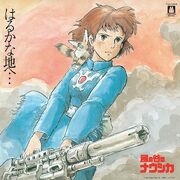
Soundtrack for Nausicaä by Joe Hisaishi. Encompass art by Hayao Miyazaki.
Nausicaa of the Valley of the Wind: Image Album (風の谷のナウシカ イメージアルバム 鳥の人 , Kaze no tani no Naushika Imēji Arubamu Tori no Hito) was released Nov 25, 1983. The 11-track album contains synthesized interpretations of the existing orchestrated tracks from the official soundtrack.
Nausicaä of the Valley of the Wind (OST) (風の谷のナウシカ サウンドトラック 〜はるかな地へ~ , Kaze no Tani no Naushika Saundotorakku ~Haruka na Chi he~) was released by Animage Records and Tokuma Japan Communications on March 25, 1984. Joe Hisaishi was hired to compose and arrange the film's score. This would be his outset involvement with Miyazaki's works.
The soundtrack featured the theme song composed by Haruomi Hosono and sung by Narumi Yasuda. Besides Hosono, Ryuichi Sakamoto, Yuji Takahashi, and Hikaru Hayashi were considered every bit the film's principal composer.[21]
Neither Miyazaki nor Takahata had any prior knowledge of Hisashi. Information technology is said the flashback song The Distant Days was sung past Mai, the daughter of Hisaishi, who was four years erstwhile at the time. Initially, Miyazaki wanted to utilize Vladimir Vysotsky'southward The Song of the Earth as the theme vocal, but couldn't acquire information technology due to copyright bug.[22]
The principal soundtrack was produced using a 50-member orchestra, and instruments such as the Prophet-5, LinnDrum, MC4, and DX7, and folk instruments such as quena, tabla, and dulcimer were used. Post-obit its release, the soundtrack to the movie ranked 8th on the Oricon album chart[23] and the theme song sung past Narumi Yasuda is ranked 10th on the single chart.[24]
Manga

The Wind Box Set up published on Nov 6, 2012 by Viz Media nerveless every volume of the "Nausicaä" manga.
Miyazaki's manga version of Nausicaä was written over a period of 13 years, with breaks taken to work on Studio Ghibli films. Serialized in Tokuma Shoten'south Animage mag, the outset affiliate was published in February 1982, and the terminal chapter in March 1994. As can be expected, the story of the manga is far more complex than that of the picture show. The tale depicted in the motion picture roughly corresponds to only the first quarter of the manga (which is all that had been written at the time the film was produced), with significant differences in plot.
In addition to the plot, there are other significant differences in the story – the characters are more developed and the environmentalist tone is more sophisticated, echoed in the complex worldview of Princess Mononoke. Nausicaä herself is portrayed as being much more potent, with abilities that are not always explained.
The Nausicaä manga is published in English by VIZ Media. Earlier editions of the English manga and fan translations oftentimes used the title Nausicaä of the Valley of Air current, omitting the definite article.
Voice Cast
| Character name | Japanese voice actor | English language voice actor (New World Pictures, 1985) | English language vocalization actor (Disney, 2005) |
|---|---|---|---|
| Nausicaä | Sumi Shimamoto | Susan Davis (Princess Zandra) | Alison Lohman |
| King Jhil | Mahito Tsujimura | Alvy Moore | Marking Silverman |
| Muzu | Unknown | James Arnold Taylor | |
| Obaba | Hisako Kyōda | Linda Gary (One-time Lady) | Tress MacNeille |
| Yupa | Goro Naya | Hal Smith | Patrick Stewart |
| Mito | Ichiro Nagai | Hal Smith (Axel) | Edward James Olmos |
| Gol | Kōhei Miyauchi | Unknown | Frank Welker |
| Gikuri | Jōji Yanami | Unknown | Jeff Bennett |
| Niga | Minoru Yada | Ken Sansom | Mark Silverman |
| Teto | Rihoko Yoshida | ||
| Children | Masako Sugaya Takako Sasuga Rihoko Yoshida Chika Sakamoto TARAKO Hisako Ayuhara | Jimmy Keegan | Paul Butcher (Guard Male child) Ashley Edner Molly Keck Jordan Orr Aimee Roldan Grace Rolek Ross Simanteris |
| Asbel | Yoji Matsuda | Cam Clarke (Prince Milo) | Shia LaBeouf |
| Lastelle | Miina Tominaga | Robbie Lee | Emily Bauer |
| Mayor of Pejite | Makoto Terada | David McCharen | Mark Hamill |
| Lastelle's Mother | Akiko Tsuboi | Patricia Parris | Jodi Benson |
| Kushana | Yoshiko Sakakibara | Linda Gary (Queen Salena) | Uma Thurman |
| Kurotowa | Iemasa Kayumi | Peter Cullen (General) | Chris Sarandon |
| Commando | Tetsuo Mizutori | Unknown | N/A |
| Pejite Citizens | Takeki Nakamura Bin Shimada | Unknown | Jeff Bennett |
| Torumekian Soldiers | Shinji Nomura Hôchû Ôtsuka | Unknown | Dee Bradley Baker Jeff Bennett John Schwab |
| Pejite Girl | Takako Ôta | Bettina Bush | Ashley Rose Orr |
| Narrator | N/A | Hal Smith | Tony Jay |
Additional Voices
- 1985 dub: Doris Hess, Daamen J. Krall, Mona Marshall (Adult female), Jan Rabson, Marilyn Schreffler, Ginny Taylor, Jeff Winkless (Gun Theft Victim), Mike Winslow
- Disney dub: Newell Alexander, Rosemary Alexander, Tom Amundsen, Stephen Apostolina, Mitch Carter, Robert Clotworthy, David Cowgill, Wendy Cutler, Ike Eisenmann, Jean Gilpin, Nicholas Invitee, Bridget Hoffman, Sherry Hursey, Rif Hutton, Edie Mirman, Richard Miro, Peter Renaday (Old Valley Man, Tolmekian Technician), James Arnold Taylor (Young Soldier), Lynnanne Zager
Credits
| Credit | Staff |
|---|---|
| Director | Hayao Miyazaki |
| Screenplay | Hayao Miyazaki, Kazunori Itō (outset typhoon) |
| Character Design | Hayao Miyazaki, Kazuo Komatsubara |
| Assistant Manager | Kazuyoshi Katayama, Takashi Tanazawa |
| Animation Check | Hideo Hiratsuka, Tadashi Ozawa |
| Animation Director | Kazuo Komatsubara |
| Assistant Key Animator | Masahiro Yoshida, Tomihiko Ohkubo |
| Key Animation | Hideaki Anno, Hidekazu Ohara, Junko Ikeda, Kazuyuki Kobayashi, Kitaro Kousaka, Makiko Futaki (uncredited), Megumi Kagawa, Michitaka Kikuchi (uncredited), Noboru Takano, Osamu Nabeshima, Shouji Tomiyama, Shunji Saida, Tadakatsu Yoshida, Tadashi Fukuda, Takanori Hayashi, Takashi Nakamura, Takashi Watanabe, Tsukasa Tannai, Yôichi Kotabe, Yoshinori Kanada, Yukiyoshi Hane |
| In-betwixt Animation | Daijirou Sakamoto, Junko Yano, Kazuhiro Ikeda, Kazuhisa Nagai, Kazuyoshi Yaginuma, Kiyo Mizutani, Kiyoko Saito, Koji Iwai, Mahiro Maeda, Masako Kondou, Sachiko Tada, Taidō Hanafusa, Taira Sanuki, Takayo Mizutani, Umanosuke Iida, Yasushi Tanizawa, Yoshiko Nakamura, Yoshiko Sasaki, Yukari Watanabe, Yukie Takahashi, Yumiko Taguchi |
| Groundwork Fine art | Hiroko Murai, Kaoru Chiba, Kazuhiro Kinoshita, Kazuo Ebisawa, Kazuo Okada, Kimiko Shimono, Kuniko Nishimura, Masaki Yoshizaki, Miyoshi Takanami, Satoshi Miura, Tatsuo Aoki, atsuo Imamura, Tetsuto Shimono, Tokue Okazaki, Toshiro Nozaki, Yoshiko Togashi, Yuuko Sugiyama |
| Color Design | Michiyo Yasuda, Fukuo Suzuki |
| Art Managing director | Mitsuki Nakamura |
| Sound Managing director | Shigeharu Shiba |
| Music | Joe Hisaishi |
| Executive Producers | Michio Kondou, Toru Hara, Yasuyoshi Tokuma |
Home Video
- Nausicaa of the Valley of the Wind VHS - Tokuma Shoten / Tokuma Japan / Tokuma Communications 148AH-3 1984, March 21, 2008, Release
- Nausicaa of the Valley of the Wind Beta --Tokuma Shoten / Tokuma Nihon / Tokuma Communications 148AB-5003 Released on March 21, 1984
- Nausicaa of the Valley of the Wind LD - Tokuma Shoten / Tokuma Nippon / Tokuma Communications 98LX-1 1984 April 21 Release
- Nausicaa of the Valley of the Wind VHD --Tokuma Shoten / Tokuma Japan / Japan ABC 98HD-1 Released on April 21, 1984
- Nausicaa of the Valley of the Wind VHS - Buena Vista Abode Amusement Released September 19, 1997
- DVD (Regular Edition)-Buena Vista Habitation Entertainment Released Nov xix, 2003
- DVD (Nausicaa Figure Ready) --Buena Vista Dwelling house Entertainment Released Nov 19, 2003
- DVD (Collector'south Box) --Buena Vista Home Entertainment Released on Nov 19, 2003
- DVD (Managing director Hayao Miyazaki's Works) -Walt Disney Studios Japan Released on July 2, 2014
- Blu-ray Disc --Walt Disney Studios Japan Released on July 14, 2010
- Blu-ray Disc (Director Hayao Miyazaki) --Walt Disney Studios Japan Released on July two, 2014
Printed Media
- Animage Comics Wide Format Nausicaa of the Valley of the Wind 1 (August 25, 1983) ISBN 4-xix-773581-2
- Animage Comics Wide Format Nausicaa of the Valley of the Wind 2 (August 25, 1983) ISBN 4-xix-773582-0
- Animage Comics Wide Format Nausicaa of the Valley of the Wind 3 (Jan 20, 1985) ISBN iv-nineteen-775514-7
- Animage Comics Wide Format Nausicaa of the Valley of the Current of air 4 (May i, 1987) ISBN 4-19-777551-2
- Animage Comics Wide Format Nausicaa of the Valley of the Air current 5 (June 30, 1991) ISBN 4-xix-771061-5
- Animage Comics Broad Format Nausicaa of the Valley of the Wind 6 (Dec xx, 1993) ISBN 4-19-773120-5
- Animage Comics Wide Format Nausicaa of the Valley of the Wind 7 (January 15, 1995) ISBN four-19-770025-three
- Nausicaa of the Valley of the Wind Luxury book (meridian / bottom) (Nov 30, 1996) ISBN 4-19-860561-0 . ISBN four-xix-860562-9
- Luxury book "Nausicaa of the Valley of the Wind" (2 volumes) (November thirty, 1996) ISBN iv-19-869901-1
- Animage Comics Wide Format Nausicaa of the Valley of the Wind All 7 Volumes (August 25, 2002) ISBN 4-nineteen-210002-9
- Animage Comics Broad Format Nausicaa of the Valley of the Wind Tormekia Campaign Version All 7 Volumes (Oct 31, 2003) ISBN 4-nineteen-210010-X
- Nausicaa of the Valley of the Current of air-Picture Conte (one ・ ii) (Animage Bait-and-switch) (March 31, 1984) ISBN iv-nineteen-669522-ane . ISBN iv-19-669523-X
- Nausicaa of the Valley of the Wind (Studio Ghibli Storyboard Consummate Works one) (June 30, 2001) ISBN 4-19-861376-1
- THE ART OF Nausicaa of the Valley of the Wind (Edited by Animage Editorial Department) (June 20, 1984) ISBN four-19-814560-1
- Nausicaa of the Valley of the Wind- Shun Miyazaki Watercolor Painting Collection (Ghibli THE ART Serial) (September 5, 1996) ISBN 4-19-810001-2
- Nausicaa of the Valley of the Wind GUIDE BOOK (Animage Special Edition Romantic Anthology) (March 1984, Reprint July 2010) ISBN iv-19-720309-eight
- Nausicaa of the Valley of the Wind-Roman Album (May 1984, Reprinted May 2001) ISBN 4-19-720155-9
- Kodansha Anime Comics 61 Nausicaa of the Valley of the Wind 1 (April 11, 1984) ISBN 4-06-174461-5
- Kodansha Anime Comics 62 Nausicaa of the Valley of the Wind 2 (April 25, 1984) ISBN 4-06-174462-3
- Kodansha Anime Comics 63 Nausicaa of the Valley of the Wind 3 (May 18, 1984) ISBN 4-06-174463-1
- Kodansha Anime Comics 64 Nausicaa of the Valley of the Wind iv (May 30, 1984) ISBN 4-06-174464-X
- Nausicaa of the Valley of the Air current (above) (Tokuma Anime Picture show Volume) (March 31, 1988) ISBN iv-nineteen-703624-viii
- Nausicaa of the Valley of the Current of air (beneath) (Tokuma Anime Picture Book) (March 31, 1988) ISBN 4-19-703625-6
- Nausicaa of the Valley of the Wind 1 (Animage Film Comic) (October 30, 1990) ISBN four-19-770101-2
- Nausicaa of the Valley of the Wind 2 (Animage Film Comic) (November 20, 1990) ISBN 4-19-770113-half dozen
- Nausicaa of the Valley of the Wind 3 (Animage Pic Comic) (November 20, 1990) ISBN 4-19-770114-iv
- Nausicaa of the Valley of the Wind four (Animage Picture Comic) (December xx, 1990) ISBN iv-19-770120-9
- Nausicaa of the Valley of the Wind Tormekia Campaign Version (Animage Film Comic Book iv) (October 31, 2003) ISBN 4-19-210011-8
- Studio Ghibli Works Related Materials Catalog I (Ghibli THE ART Series) (June 30, 1996) ISBN iv-19-860525-four
- Ghibli Textbook 1 Nausicaa of the Valley of the Wind (Bungei Ghibli Bunko) (Apr 10, 2013) ISBN 978-4-sixteen-812000-8
- Movie theatre Comic 1 Nausicaa of the Valley of the Wind (Bungei Ghibli Bunko) (April 10, 2013) ISBN 978-4-sixteen-812100-5
Music
- Nausicaa of the Valley of the Wind Image Album Bird People ... (Cassette 25AN-13 / LP ANL-1013) Tokuma Japan Communications (November 25, 1983)
- Nausicaa of the Valley of the Wind Epitome Album Tori no Hito ... (CD TKCA-72716) Tokuma Japan Communications ((Reissued August 25, 2004) (Original CD / November 25, 1983))
- Nausicaa of the Valley of the Air current Symphony Edition ~ The Fable of the Air current ~ (CD TKCA-72718) Tokuma Japan Communications ((Reissued August 25, 2004) (Original CD / February 25, 1984))
- Nausicaa of the Valley of the Wind Drama (CD TKCA-70135) Tokuma Nippon Communications ((Reissued July 21, 1993) (Original CD / February 25, 1984))
- Nausicaa of the Valley of the Wind To the Far Land ... (CD TKCA-72717) Tokuma Japan Communications ((Reissued August 25, 2004) (Original CD / March 25, 1984))
- Nausicaa of the Valley of the Air current Best (CD) Tokuma Nihon Communications (November 24, 1986)
- Nausicaa Hi-Tech Series in the Valley of the Wind (CD TKCA-72719) Tokuma Japan Communications ((Reissued August 25, 2004) (Original CD / July 21, 1993))
- (Theme song) Nausicaa of the Valley of the Wind (CD) Narumi Yasuda, C / Due west "Fairy of the Wind" Tokuma Japan Communications ((Reissue CD / October 2004) (Original tape / June 1985))
- Piano Music Collection Nausicaa of the Valley of the Wind Image Anthology & soundtrack Kay G. P. Kikubaiban (June 2008)
- Studio Ghibli Hayao Miyazaki & Joe Hisaishi Santra BOX [Box set, Express Edition] (CD) Tokuma Japan Communications (July xvi, 2014)
Toys, models, etc.
- Nausicaa of the Valley of the Wind Meaty Cassette (Blazon-1 Normal Position / C-46) Tokuma Communications Part No. TTC-one ~ 3
- In the mid-1980s, TEAC and others released it, and the cassette record in the normal position using a hub similar to an open reel, which was pop with audiophiles, was sold for 560 yen. Only C-46 (46 minutes round trip / 23 minutes one way) is sold.
- Plastic models and colossal figures such as Nausicaa, Ohmu, Möwe glider, and Gunship have been released by Tsukuda Hobby . In 2011, Bandai released the loftier-terminate toy "FORMANIA Gunship".
- A model gun that reproduces Nausicaa's long gun was sold by Buena Vista. Produced by Maruzen. Limited to 100 pieces, the cost is 350,000 yen.
References
- ↑ "Starting Point (1979-1996)", Hayao Miyazaki
- ↑ Proposal to Acquire Picture Rights, Hayao Miyazaki (November 1980)
- ↑ Miyazaki, Hayao (June 15 1983). Ogata, Hideo (ed.). シュナの旅 [The Journey of Shuna (in Japanese). Tokyo: Tokuma Shoten.]
- ↑ Animage Editorial Department, "The Road to Nausicaa," "The Art of Nausicaa," Tokuma Shoten, 1984, p.182.
- ↑ Kano (2006).
- ↑ Hideo Ogata, "Shoot That Flag," Blitheness "Blood Record," Oakla Publishing, 2004, p.177.
- ↑ Makoto Kanazawa , Yasuyoshi Tokuma, Bunka Tsushinsha, 2010, pp. 130-131.
- ↑ "Blown past the Wind", Toshio Suzuki. Published by Chuokoron-Shinsha
- ↑ Suzuki (2005), p.72. Suzuki (2008), p.42.
- ↑ Kano (2006), p.42.
- ↑ Ogata (2004), p.183.
- ↑ Yuichiro Oguro "25th Takashi Watanabe " "I want to talk to this person Anime Professional Piece of work 1998-2001" Asukashinsha , November 2, 2006, ISBN 4-87031-758-3 , p. 415.
- ↑ "Starting Point (1979-1996), Pp. 392-393
- ↑ "On Completing Nausicaä of the Valley of the Wind - The Story Continues", Iwanami Shoten (June 1994)
- ↑ "Roman Album Extra 61 Nausicaa of the Valley of the Wind" Tokuma Shoten, 1984, p.130
- ↑ "How was that masterpiece born? "Nausicaa of the Valley of the Air current" The hole-and-corner story of the shocking production!", Hatena Web log
- ↑ "Decoding Nausicaa - The Criticality of Utopia" (Interview with Shinichiro Inaba and Hayao Miyazaki, p.211 and p.215)
- ↑ "I learned a piddling more about Nausicaa than a while agone. Long Interview Hayao Miyazaki" "Comic Box" VOL.98 Jan 1995 issue, p.21.
- ↑ "The Wind Rises Hayao Miyazaki (Manager) x Hideaki Anno (Starring) x Yumi Matsutoya (Theme Song), 90 Minutes Talk!" " Kinema Junpo " Early August 2013 issue, p.66.
- ↑ "Manager Hayao Miyazaki: Nausicaa sequel" No "Principal remarks at the retirement interview" " Mainichi Shimbun " September 6, 2013.
- ↑ Toru Iwakiri "Modern Portrait Joe Hisaishi Composer" "AERA" November 1, 2010, Asahi Shimbun Publishing, p.72.
- ↑ "Nausicaa of the Valley of the Wind Image Album" Liner Notes.
- ↑ Oricon Chart Book LP, 1970-2001" Original Confidence, 1990, p. 332. ISBN 4871310256
- ↑ "Oricon Yearbook 1985 Edition" Original Confidence, 1985, p18.
External Links
Official Sites
-
 Nausicaä of the Valley of the Wind on Studio Ghibli
-
 Nausicaä of the Valley of the Wind on Walt Disney Nihon
-
 Nausicaä of the Valley of the Current of air on GKIDS
-
 Nausicaä of the Valley of the Wind on HBO Max
Information
-
 Nausicaä of the Valley of the Current of air on Anime News Network
contrerasfouns1988.blogspot.com
Source: https://ghibli.fandom.com/wiki/Nausica%C3%A4_of_the_Valley_of_the_Wind
0 Response to "Art of Nausicaãƒâ¤ of the Valley of the Wind"
Post a Comment