What Are Some Things That Changed in Family and Education During the 1920's?

Mention of the "Roaring Twenties" might conjure images of flappers and extravagant spending, but this wasn't the norm for the average family during this decade. While daily activities were dissimilar for people living in rural and urban areas, family values in the 1920s remained relatively constant.
Leisure Time
At habitation, families with a bombardment-powered radio could heed to radio shows. These early radios ofttimes simply had 1 headphone instead of a speaker, so kids would fight over who got to listen to which shows.
Gender Roles
Although many aspects of the 1920s lifestyle were irresolute, men and women still mostly held the traditional roles of decades passed. Men typically worked long hours in professions involving hard labor. Despite the prototype of the 1920s woman equally independent and rebellious, a 1920s mother still took on caring for children and taking care of household tasks equally her primary job. Each person within a household had male or female roles and saw the value in these tasks as a ways to encounter all the needs of the family as a whole.
Matrimony in the 1920s
In 1920, nearly 2-thirds of all people over age 14 were married (page 20 of the Historical Statistics Study) while only around 250,000 out of 37 million people were divorced. The boilerplate historic period at showtime matrimony in 1920 was 24 for men and 21 for women (page 19 of the Historical Statistics Report). Although matrimony rates were high for virtually people, past 1920 Black women were more than probable to be married than white women. In general, men and women wanted to be married and stay married.
Non-White Families

For many not-white families, cultural identity and racial pride were important values as minorities sought to gain better treatment. Because of their job opportunities, in terms of economics and dangerous work weather, minority families included more extended family living together.
Birth Control
Thank you to advances in birth control, like the legalization of condoms and availability of the diaphragm, couples had more than control over how many kids they had. An average household during this decade consisted of almost four people (page 41 of the Historical Statistics Written report).
Child Rearing
Parents started to shift their thinking from traditional views of the family unit as a hierarchy to a more emotional approach. Affectionate views of immediate family members meant husbands and wives saw each other equally friends, and viewed their kids as friends too.
Changes for Rural Families
Upwards until 1920, the majority of white Americans lived in rural areas. However, according to Census.gov, by 1920 more than half of Americans were living in cities and towns. While there were now technically more than urban dwellers, most half of all families still lived on farms. In dissimilarity, while many African American families did movement north during this decade, they were still more likely to reside in rural areas. The same is true for people identified as being from "other races" by the U.S. Census Bureau.
Work

Rural families embraced subcontract life among the changing landscape of the world. Because in that location was so much work to do all the time, every fellow member of a farm family worked on the farm. Men mostly worked in the fields or on building and repairing the homestead and equipment. Although the product industry was making strides in the invention and mass production of machines, this motion had non notwithstanding reached farms. Since most farmers were however completing all work past hand, neighbors helped each other with large harvests to get the work done before seasons changed.
Wives and mothers nonetheless tended to household chores similar sewing, cooking, canning, and caring for babies. Only, they also helped with piece of work in the fields when needed. Farm women fabricated sure everyone, peculiarly the hardworking men, were taken intendance of, as a means to keep the family unit prepared for long days.
Childhood
Children on farms in this decade were called upon to aid with the workload as before long as they were able. Chores like feeding animals, gathering eggs, or chopping wood were common for younger children. Once the chores were done for the day, kids would walk or ride a horse up to 2 miles to become to the closest school. Children spent most 8 years in principal schoolhouse, with summers off, memorizing poems and playing games. Older children could attend loftier school in the nearest town if there was a high school, and if they could get there.
Leisure Fourth dimension
Life in 1920s rural America wasn't all work, although that is how people spent most of their fourth dimension. Families enjoyed schoolhouse presentations or finish of the year picnics where they could gather with neighbors. Churches held gatherings, potluck dinners, and water ice cream socials as a way to bring people together for fun. Trips to town were too a favorite pastime for families. In the summer when they had goods to sell, families could visit the town and watch movies projected onto the side of a building.
Other popular town events were horse races or the Chautauqua, a tent with lectures, plays, and music open to the public. In the country, kids could go swimming in nearby creeks and streams or go fishing.
Changes for Urban Families
Thanks to electricity and indoor plumbing, household chores were made easier for those who could afford vacuum cleaners and similar inventions. Lights also made it possible for people to stay upwardly after in cities and partake in more activities.
Piece of work
Town and city workforces took on a more than diverse wait during the 1920s. At this time, at that place was a large-calibration relocation of Blackness families from the rural South to the urban north, because of their demand to detect better jobs; although they still served as a source of cheaper labor. In 1890 virtually 10 percent of African Americans lived in the north, only by 1930 near 20 per centum lived there. Black women whose husbands worked outside the home were twice as likely as white women in the same scenario to work outside the home. These women were besides more than probable to be the caput of a household, not because of depression marriage rates, only because Black men had higher mortality rates due to occupational hazards and other factors than white men.
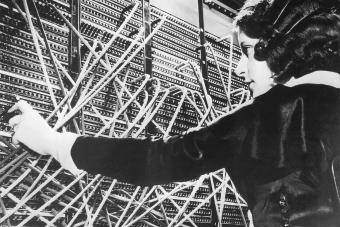
The prevalence of women in the workforce rose 25 pct during this time because many women had taken jobs outside the home during WWI. Millions of women in cities and towns worked in jobs like a stenographer, secretary, telephone operator, store clerk, or manufactory worker. Roughly 15 percent of white women whose husbands worked exterior the abode likewise worked exterior the home in the 1920s.
Childhood

Metropolis kids worked in jobs outside the dwelling like selling newspapers, shining shoes, or in factories to assistance support their family. Information technology wasn't until 1938 that child labor laws were well-regulated by the government.
When they weren't working or helping their parents, all kids ages 8-xiv were required past all states to nourish school for part of each year. City schools were separated into schoolhouse districts with public school funded by country and local taxes. This led to inequality in educational standards based on the surface area where a kid lived. Wealthy school districts had access to well-trained teachers and amend books, while poor school districts had few resources. Although enrollment in schools was on the rise during this decade, these stark differences in educational supplies and resources were evident in the fact that about 15 pct of white people older than fourteen, native or foreign-built-in, were illiterate in 1920, while 23 pct of Blacks and people of other races were illiterate.
Leisure Time
City families had better access to real movie theaters often called "picture palaces" because they were so large and extravagant. Theaters included extras like a children'due south nursery, lounges, and even trip the light fantastic floors to entice people to visit regularly. By the end of the 1920s, about iii-fourths of Americans visited movie theaters on a weekly basis.
A Balancing Human action
Families of all types were looking to meliorate their private and collective lives during the 1920s. This decade supported a variety of lifestyles, just most family units were striving to stay intact, work together for mutual goals, and detect fourth dimension for fun.
© 2022 LoveToKnow Media. All rights reserved.
contrerasfouns1988.blogspot.com
Source: https://family.lovetoknow.com/about-family-values/family-life-1920s
0 Response to "What Are Some Things That Changed in Family and Education During the 1920's?"
Post a Comment